
National Landing was born out of the natural connectivity and shared sense of place among Crystal City, Pentagon City, and Potomac Yard. Its proximity to the Pentagon and Washington DC make it ideal for trailblazers in defense, aerospace, and next-gen government tech; and the plethora of transit options make it easy to access that network.
And that transportation infrastructure has only continued to grow. National Landing is now in the middle of a major transit investment, with nearly $64 billion of public spending in projects either underway or funded and scheduled—projects impacting rail, roadways, Metro, pedestrians and bikers, and more.
It’s all part of making National Landing the most connected downtown in America. Here’s what is underway:
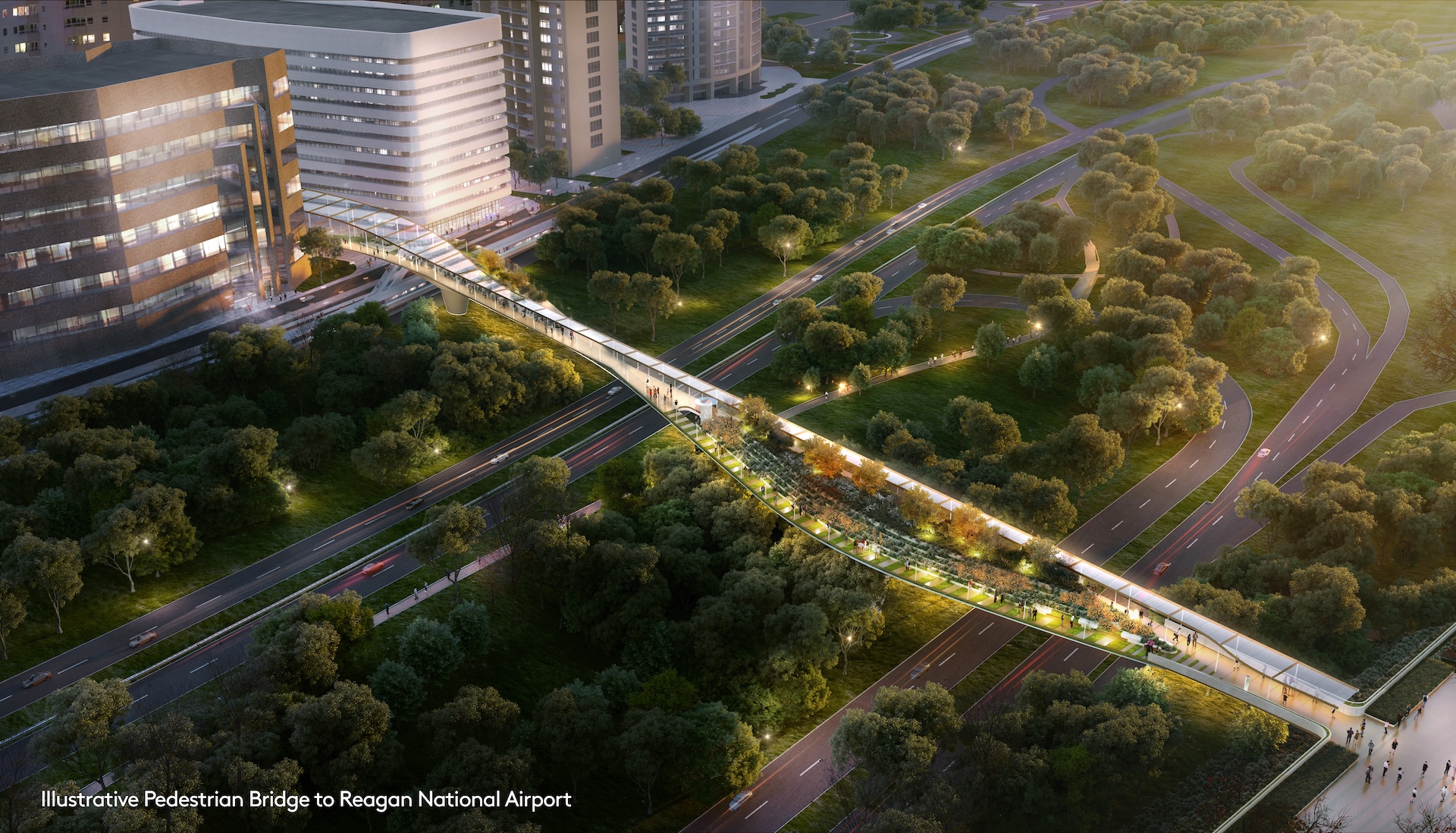
The CC2DCA Pedestrian Bridge
The most significant new infrastructure will provide a direct, walkable connection between Crystal Drive in National Landing and Ronald Reagan Washington National Airport (DCA). The CC2DCA bridge will cross above the George Washington Memorial Parkway, allowing pedestrians and bicyclists to get to the airport in just minutes. It will also link to the Mount Vernon Trail and the Crystal City Metro station.
The appeal is substantial for businesses: Executives, investors, potential recruits, and others from anywhere can fly into DCA, walk across the bridge, and within moments be at a meeting in National Landing.
With environmental review complete and final design underway, construction is projected to begin in late 2031 and last approximately two years. Once construction is complete, the CC2DCA bridge will be approximately 1,300 feet long and 20 feet wide. It will also feature benches, viewpoints, and landscaping, but some of the details are still being resolved, such as where elevators and/or escalators will be installed and if the bridge will be fully covered.
New and Updated Metro and VRE Stations in Crystal City
Construction is underway on a new second entrance at the Crystal City Metrorail Station, and when it opens in the second quarter of 2027, commuters will have easy access to the shops and restaurants along Crystal Drive. The new entrance, rising at the northwest corner of 18th Street South and Crystal Drive, will feature a street-level lobby with faregates and fare vending machines, putting riders just steps from Crystal Drive’s retail corridor. It will also include elevator upgrades for ADA accessibility.
In conjunction with the CC2DCA bridge, the Crystal City VRE (Virginia Railway Express) station will be relocated and expanded to better serve commuters and create more efficient connections to the airport, Metro, and other transportation options. The new location will allow the station to feed directly into the CC2DCA in a true intermodal design.
The new station will also feature a longer platform to accommodate more VRE trains, but also lay the foundation to connect Amtrak and MARC train service in the future.
The Long Bridge Project
Led by the Virginia Passenger Rail Authority, the Long Bridge Project will help relieve one of the biggest rail bottlenecks on the East Coast. The project, which is already under construction, includes five new rail bridges and two new bridges for pedestrians and cyclists. Significantly, it will add a second two-track rail bridge over the Potomac River next to the existing one, where bottlenecks currently often occur. This will improve the experience of countless workers, potential recruits, customers, and others traveling to National Landing and beyond.
The bike and pedestrian will connect Long Bridge Park and the Mount Vernon Trail in Arlington to East Potomac Parks in DC, continuing to expand options for non-vehicular travel across the area.
Reachable from Everywhere
These developments, along with continued work to improve bicycle infrastructure and pedestrian paths across the region, mean National Landing will be one of the most well-connected neighborhoods in the country—just steps away from anywhere in the world. Whether by plane, train, Metro, bike, commuter rail, or even foot, it will be easier than ever to arrive at and move through National Landing. This access makes a difference: convenient for conducting business with partners near and far, ideal for meeting and event spaces, and easy for those looking to live car-free.